
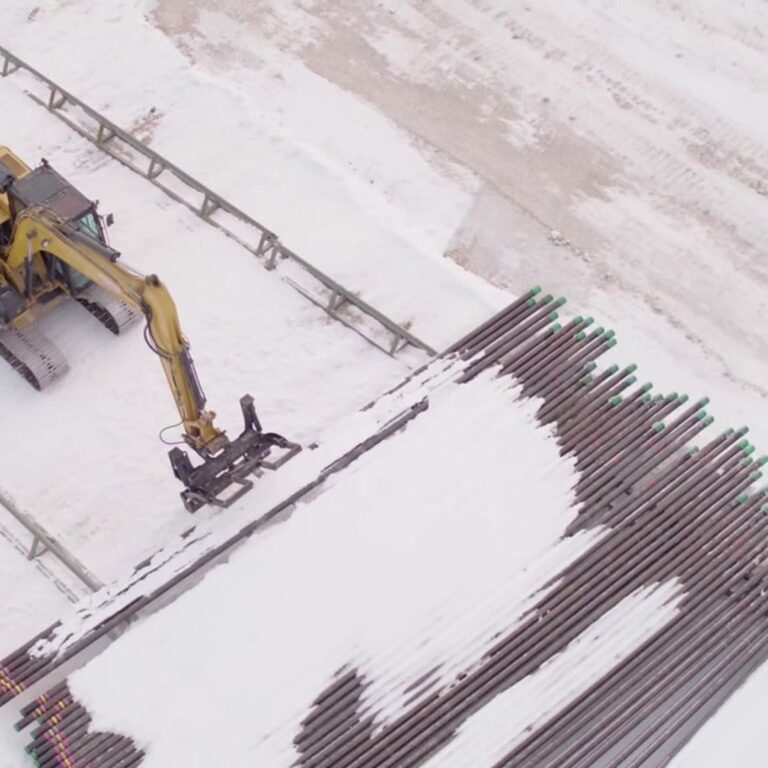
Cold Weather Casing Running: Compound, Hydraulics, and the Crew
Cold changes the physics on a casing job before it changes anything else. Hydraulic fluid thickens, thread compound stiffens, and a crew’s working window shortens. None of that changes what a good connection looks like on the torque-turn graph. It changes what it takes to get there.
Thread compound behaves differently
Compound rated for warm conditions goes stiff in the cold and stops spreading evenly across the threads. API 5A3 requires thread compound to stay brushable in cold weather, and not every compound on the truck meets it. Uneven compound shows up as make-up torque out of window and, on shouldered connections, shoulders landing off target. The fix is a compound rated for the temperature on location, stored warm until it is applied, and applied the same way on every joint. Consistency matters more in January than in July because the margin for error is smaller.
Hydraulics and seals need a warm-up plan
Tongs, power units, and bucking equipment run on hydraulic fluid that thickens as the temperature falls. Cold fluid means slow response, higher pressure spikes, and seals under stress. Elastomer seals stiffen in the cold too, on the tongs, on the power unit, and on every tool that depends on them, which is one more reason the warm-up happens before the first connection. Equipment gets warmed before the first make-up, not during it, and the warm-up is part of the job plan rather than something the crew improvises when the first connection feels wrong.
The torque reading does not move with the cold
Hydraulic load cells lose accuracy as the temperature changes. ProTorque runs electronic load cells on its torque systems, which do not carry that error, and verifies them on a set schedule in its facilities rather than waiting for a cold job to show a problem. The graph reflects what happened to the threads, not what the weather did to the sensor.
Ice and snow on threads are an inspection problem
Moisture that freezes on a pin or box before make-up becomes debris under compound. Thread protectors stay on until the joint is picked up, threads are inspected and cleaned at the point of make-up, and anything that came off the truck with ice in the threads gets cleaned before it goes in the string. This is where tubular thread cleaning and inspection earns its place on a winter program.
The crew is the first system that degrades
Cold shortens attention spans and fine motor control long before it stops work. Warm-up rotations, daylight planning, and a pre-job meeting that names who is watching for what keep the crew ahead of the conditions instead of reacting to them. A rushed connection in the cold is the one that gets pulled.
What doesn’t change
Every connection still gets a torque-turn graph. Every graph still goes in the well file. The standard for a good make-up is the same at any temperature. Cold weather readiness is about protecting that standard when the conditions are working against it.
Planning a winter casing program? ProTorque crews run cold weather programs every season with the same documentation on every connection. Contact us at the planning stage.